
Mount Somers Manuka Honey
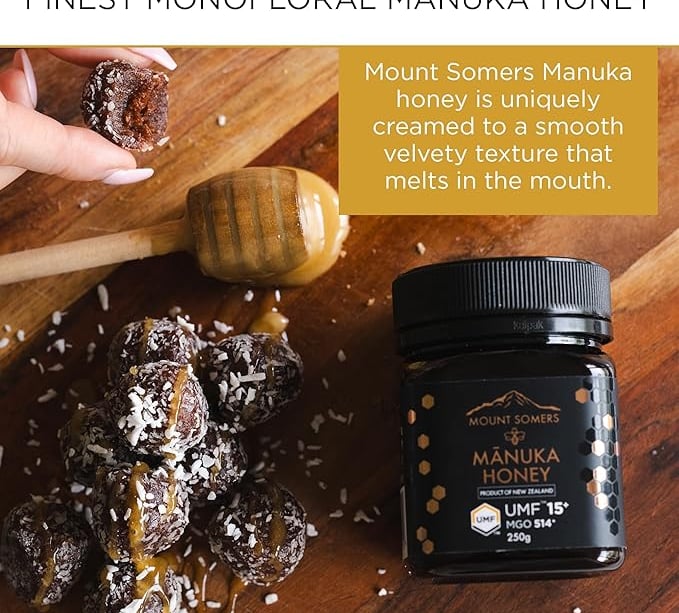
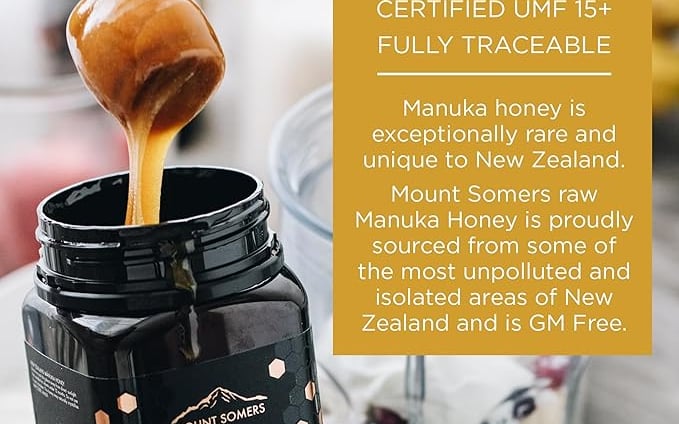
Manuka honey naturally contains high levels of MGO, which stands for Methylglyoxal, which is the key antibacterial component that makes Manuka honey different from regular honey.
The higher the MGO number on a Manuka honey label (e.g., MGO 100+, 250+, 550+), the stronger its antibacterial activity.
Analytical studies report that Manuka honey typically contains about 40–800 mg/kg of MGO, and in some samples up to ~1900 mg/kg, which is far higher than in conventional honeys. Source Merck Millipore and PubMed.


Reviews
What our customers say about our Manuka honey
Creamy, tasty manuka honey. I always keep some on hand. I stir it in tea, or direct off the spoon. Nice for flavor, for soothing scratchy throat. Maybe one of the many benefits will pique your interest. I like regular honey for most uses, but I enjoy the unique flavor of manuka. Kinda hits the spot when you want a little something sweet.
Anna L.


Toronto ON
I found this honey to be just as good as the higher-strength ones at a lower price. I wasn't allowed to say how good it is for me! Cheers! Buy it! But leave some for me! :)


Kim M.
Denver CO
★★★★★
★★★★★
FAQs
Does Manuka honey support wound and skin healing when used on the skin?
Topical manuka honey can support wound and skin healing, with clinical trials showing faster healing times in some ulcers and burns compared with standard dressings.
A Cochrane review of honey dressings found that in partial-thickness burns, honey shortened healing time by about 4.7 days compared with some conventional dressings. PubMed.
In a randomized trial of neuropathic diabetic foot ulcers, manuka honey–impregnated dressings reduced mean healing time to 31 ± 4 days vs 43 ± 3 days with conventional dressings and achieved similar overall healing rates (97% vs 90%). PubMed
Can Manuka (and other) honey help soothe sore throats and cough?
Honey, including Manuka, can help soothe sore throats and nighttime cough, with trials showing better symptom relief than no treatment and similar effects to common cough medicines in children.
A Cochrane review of honey for acute cough in children (3 RCTs, 568 participants) found honey reduced cough frequency more than no treatment (mean difference about −1.05 points on a 0–6 scale) and placebo, with a similar effect to dextromethorphan. Cochrane
A JAMA Pediatrics RCT reported that honey produced greater improvements in nocturnal cough frequency and sleep quality than dextromethorphan or no treatment in children with upper respiratory infections. PubMed
Does Manuka honey support the immune system?
Cell-based studies show manuka honey can modulate immune cell signaling and cytokine release, but clear clinical evidence for general immune support in humans is still limited.
In a differentiated neutrophil (dHL-60) model under inflammatory conditions, manuka honey at 0.5–3% modulated cytokine and chemokine release (e.g., lowering TNF-α, IL-1β, MMP-9 at certain concentrations) in a dose-dependent way, indicating immune-modulating activity at the cellular level. PubMed
In monocyte/monocytic cell line studies, manuka and other honeys stimulated inflammatory cytokine production (TNF-α, IL-1β, IL-6) via TLR4-dependent mechanisms, showing that honey components can activate innate immune cells. PubMed
Does Manuka honey provide antioxidant support?
Manuka honey shows antioxidant activity in lab and animal studies, increasing antioxidant capacity and lowering oxidative-stress markers.
A 2024 study comparing manuka honey with another honey found manuka to be rich in phenolic compounds and to show strong in-vitro free-radical scavenging and NO/H₂O₂-scavenging activity; in rats with induced inflammation, manuka increased total antioxidant capacity and reduced oxidative stress markers. PubMed
In a rat model of chronic gastric ulcer, manuka honey treatment significantly reduced lipid peroxidation and inflammatory cytokines (TNF-α, IL-1β, IL-6) and increased antioxidant enzymes (GPx, SOD) and glutathione compared with untreated controls. PubMed
Can Manuka honey help with digestive or gut comfort?
Animal studies suggest manuka honey can reduce inflammation and oxidative stress in the gut, but human evidence for digestive symptom relief is still preliminary and under investigation.
In a rat model of chronic gastric ulcers, oral manuka honey significantly reduced ulcer index, lowered inflammatory markers (TNF-α, IL-1β, IL-6), and improved antioxidant status in gastric tissue. PubMed
Animal models of colitis show that manuka honey (5–10 g/kg) reduced colonic inflammation and oxidative stress and improved histological and biochemical parameters compared with untreated controls. PubMed
A 2025 feasibility RCT is currently testing Lepteridine-standardised mānuka honey for functional dyspepsia symptoms in adults; results are pending, so no human efficacy data yet. PubMed
Contact
Contact us for inquiries and support.
Connect